Chimney leak, roof leak or ice dam? 24/7 emergency line - (800) 555-0207
πŸ“ Newtown, CT Β· Fairfield County

Masonry & Roofing Contractors in Newtown, CT

Higher elevation means more snow load, more ice dams and a longer freezing season, which is exactly what breaks mortar, crowns and unreinforced garden walls. We list masonry and roofing contractors serving Newtown and the rest of Fairfield County, Connecticut. Browse contractors working in and around Newtown and ask for a written assessment before you commit to anything.

⚑ Fast local dispatch βœ… Local pros onlyπŸ’¬ Free quotesπŸ”Ž Google-verified reviews

Free quotes in Newtown

Prefer to talk now? Call (800) 555-0207

Water coming through a chimney, roof or foundation wall? Get a local pro on it today. πŸ“ž Call (800) 555-0207

Get Matched With masonry and roofing contractors in Newtown

Tell us what you need and we'll connect you with available local pros. Free, no obligation.

Prefer to talk now? Call (800) 555-0207

Masonry & Roofing Contractors services in Newtown

🧱

Chimney repair & rebuilding

Cracked crowns, spalling brick, loose top courses and leaks at the flashing, the single most common masonry call in Newtown.

πŸͺ¨

Tuckpointing & repointing

Cutting out eroded joints and repacking them with mortar matched to the original, so the brick is protected instead of destroyed.

πŸ—οΈ

Brick, block & stone masonry

Restoration and new work in brick, block, fieldstone and brownstone: piers, veneer, steps, stoops and chimney stacks around Newtown.

πŸ’§

Foundations & waterproofing

Crack injection, repointing stone foundations, interior perimeter drains, sump systems and exterior excavation and membrane work.

πŸ§—

Retaining walls, steps & walkways

Failing, bulging or leaning walls rebuilt with a proper base below frost depth, free-draining backfill and drainage that actually works.

🏠

Roofing, gutters & ice dams

Leak tracing, flashing, repairs and full re-roofs, plus the gutter, ventilation and insulation work that stops ice dams in Newtown.

Masonry & Roofing Contractors in Newtown: what to know
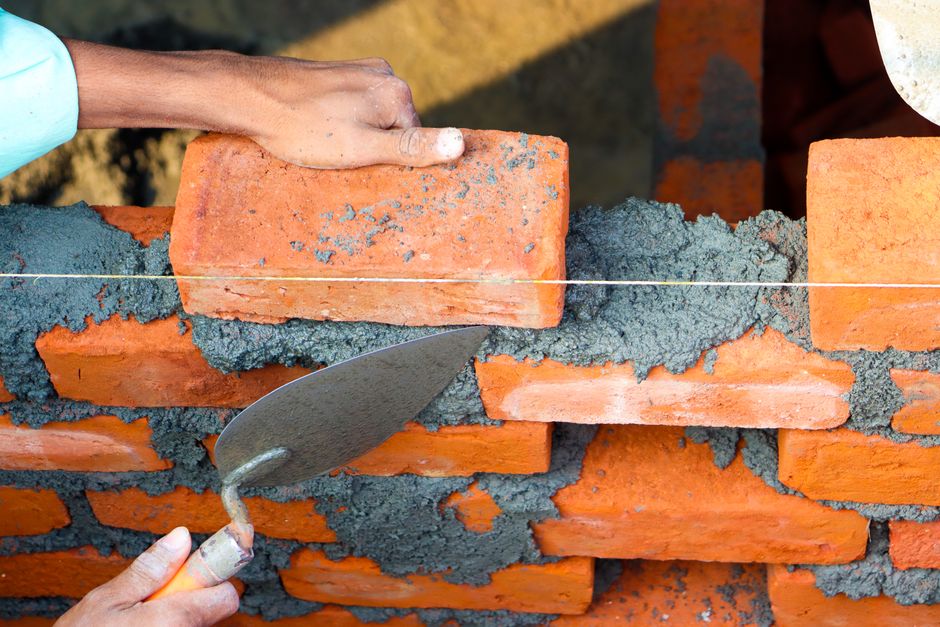
Hands laying bricks with cement in a construction setting, showcasing precise masonry work.
Stock photograph. Brick laid into a bed of fresh mortar. Not a job site in Newtown, and not work by any contractor listed above.

A harder winter than the shoreline gets

Inland and uphill from the Sound, Newtown sits in the colder half of Connecticut. More snow sits on roofs for longer, so any heat escaping into the attic produces meltwater that refreezes at the cold eave and builds an ice dam. More freeze-thaw cycles work on every mortar joint, chimney crown and concrete step. Deeper frost penetration heaves anything founded too shallow, which is why so many failed garden walls and stoops in Fairfield County turn out to have been built on six inches of gravel.

This is also stone country. Fieldstone foundations, dry-laid walls and stone steps are a normal part of properties around Newtown, and they need masons who understand how a dry-laid wall actually carries load and drains, not just how to stack a face that looks right for two seasons.

Reading the condition of your masonry

You can learn a lot about a Newtown building from the ground. Run a key along a mortar joint: if it scratches out as sand, the joint is spent and the wall is taking on water. Look for joints recessed more than a few millimetres behind the face of the brick: that is a joint no longer shedding water. Look for the white bloom of efflorescence, which means water is moving through the masonry and carrying salts out with it. Look for brick faces that have popped off, exposing the softer core; that is usually the signature of frost, of a hard repointing mix, or both.

On a chimney, look at the crown from a window or with binoculars. Cracks radiating from the flue, a crown flush with the brick instead of overhanging it, and a missing flue cap are the three things that account for most chimney leaks in Connecticut.

Where roofs and masonry meet

Most roof leaks are not roof leaks. On a Newtown home the water usually enters at a junction, the chimney, a wall, a dormer cheek, a skylight curb, a valley, and the junction is where masonry and roofing trades meet. That is exactly the seam where responsibility gets passed back and forth: the roofer says the chimney is failing, the mason says the flashing is wrong. Often both are true. Using a contractor comfortable with both sides of that detail, or making sure the two trades are coordinated in one scope, saves a second call in a year.

Proper chimney flashing means step flashing woven into the shingle courses, plus counter-flashing let into a cut or raked mortar joint and sealed. A bead of roof cement smeared over the junction is not flashing; it is a two-year fix that is very common on older re-roofs.

Permits, registration and paperwork

Permitting in Connecticut is handled town by town, so the rules that apply in Newtown are set by the local building department and can differ from a neighbouring town. As a rule of thumb, full re-roofs, structural masonry work and retaining walls above a threshold height need permits and sometimes an engineered design; small repairs usually do not. The contractor should pull the permit, and you should see it.

Separately, home improvement work on existing Connecticut homes generally requires the contractor to be registered with the state Department of Consumer Protection as a Home Improvement Contractor. Verify that registration is current before work starts, get the contract in writing, and keep every document: it is what protects you if something goes wrong later.

8Connecticut counties covered
315CT cities, towns & villages listed
24/7Emergency call line
FreeQuotes, no obligation

Common questions in Newtown

Who is responsible when a chimney leaks, the roofer or the mason?
It depends on the entry point, which is why a diagnosis should come before a quote. In Newtown, contractors who do both roofing and masonry can usually resolve it in one visit; otherwise expect a hose test to establish whether it is the flashing or the stack.
Can masonry repairs be done during a Connecticut winter?
Emergency measures yes, permanent repairs mostly no. Mortar needs curing temperatures above about 40Β°F and protection from freezing, so most Newtown masons will stabilise a problem in winter and schedule the real repair once temperatures hold.
What does tuckpointing actually involve?
Cutting or raking the deteriorated mortar back to sound material, typically around 20 to 25 millimetres deep, cleaning the joint, and packing in new mortar matched to the original in strength and appearance. Anyone in Newtown proposing to smear new mortar over old joints without cutting them out is not repointing.
Should I waterproof my basement from the inside or the outside?
Outside is more thorough and considerably more expensive because it means excavating. Interior drainage to a sump handles chronic seepage well. In Newtown the sensible order is to fix the water delivery outside first, then interior drainage, then exterior excavation only if it is still warranted.
Does it cost anything to use this directory?
No. Searching Newtown listings and requesting quotes here is free and there is no obligation to hire anyone. We are an independent directory and referral service, not a contractor, and we do not perform the work ourselves.
What paperwork should I get before work starts in Newtown?
A written contract with a defined scope, materials and payment schedule; proof of the contractor's current Connecticut Home Improvement Contractor registration; a certificate of insurance from the insurer; and confirmation of who is pulling any permit with the Newtown building department.

Also serving near Newtown

All of Fairfield County β†’

πŸ“ž Call now: (800) 555-0207