Masonry & Roofing Contractors in Old Saybrook Center: what to know
What the Sound does to buildings
Exposure to the Sound shortens the life of everything on the outside of a Old Saybrook Center building. Salt spray and salt-laden fog keep mortar joints wet, accelerate corrosion on flashing, fasteners and gutter hardware, and drive the crystallisation cycle that spalls the faces off brick and brownstone. It is why two identical chimneys, one in Middlesex County near the shore and one thirty miles north, age at very different rates.
Wind is the other half of it. Coastal Connecticut regularly sees storm winds that push rain sideways and lift the seal strips on asphalt shingles without removing them, leaving a roof that looks intact and is no longer watertight. When a Old Saybrook Center homeowner reports a leak that only appears in a particular storm direction, an experienced contractor starts at the flashing on that elevation rather than in the field of the roof.
Freeze-thaw is the local enemy
Connecticut sits in a temperature band that crosses freezing repeatedly through the winter rather than staying cold. That is worse for masonry than a colder, more stable climate. Each crossing takes water that has soaked into a mortar joint, a crown, a step or a spalled brick face and expands it by roughly nine percent, opening the void a fraction. Repeated forty or fifty times a season, that is what turns a hairline crack in a chimney crown into a channel, and a sound joint into an eroded one.
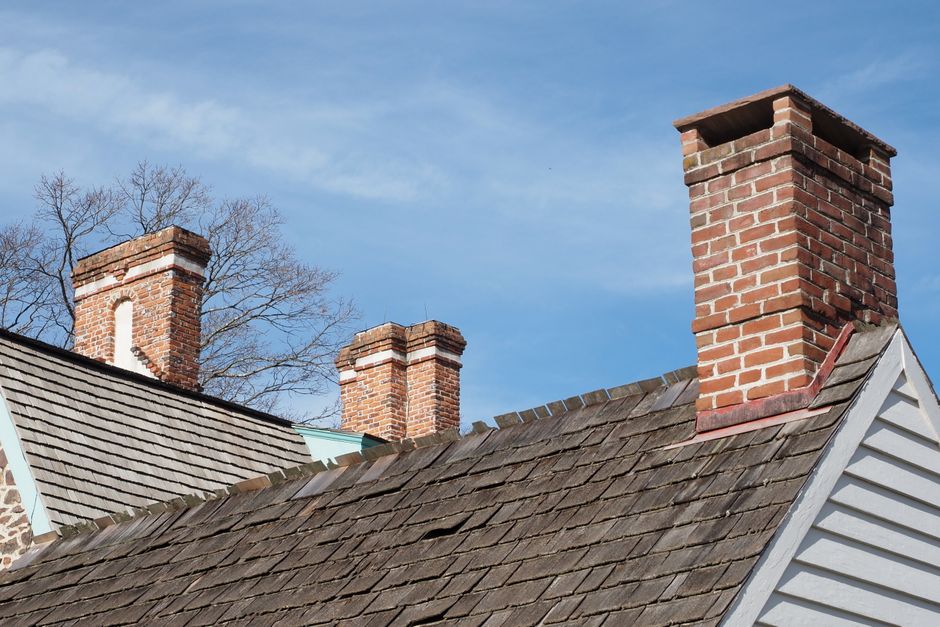
Around Old Saybrook Center this shows up first on the most exposed surfaces: chimney crowns and top courses, the south and west faces of a stack, the top of a retaining wall, concrete steps and porch landings. Those are the areas worth photographing every autumn so you can see the rate of change rather than discovering it as a leak.
Where roofs and masonry meet
Most roof leaks are not roof leaks. On a Old Saybrook Center home the water usually enters at a junction, the chimney, a wall, a dormer cheek, a skylight curb, a valley, and the junction is where masonry and roofing trades meet. That is exactly the seam where responsibility gets passed back and forth: the roofer says the chimney is failing, the mason says the flashing is wrong. Often both are true. Using a contractor comfortable with both sides of that detail, or making sure the two trades are coordinated in one scope, saves a second call in a year.
Proper chimney flashing means step flashing woven into the shingle courses, plus counter-flashing let into a cut or raked mortar joint and sealed. A bead of roof cement smeared over the junction is not flashing; it is a two-year fix that is very common on older re-roofs.
Checking out a Connecticut contractor
Contractors performing home improvement work on existing Connecticut homes are generally required to hold a Home Improvement Contractor registration with the state Department of Consumer Protection, and you can look up a registration yourself before signing anything. Connecticut also requires certain home improvement contracts to be in writing with specified terms, and maintains a Home Improvement Guaranty Fund that may help homeowners in defined circumstances, check DCP for the current requirements and eligibility rules rather than relying on what a salesperson tells you.
Beyond registration, ask any Old Saybrook Center contractor for a certificate of insurance sent directly from their insurer, a written scope that names materials and methods rather than just a total, and references for masonry work of the same type and age. Do not pay in full up front.